 Putting the A in STEM
Real standards. $14.99 a month.
Hands-on STEM + art projects for afterschool and homeschool, mapped to real education standards.
Standards
Mapped to real NGSS and state standards. See them on every project.
Price
$14.99/month unlocks the printable packs for the whole library.
Browsing is free. Create an account, then subscribe from Account.
Running a program instead of a single family? Talk to us about a site license.
How it works
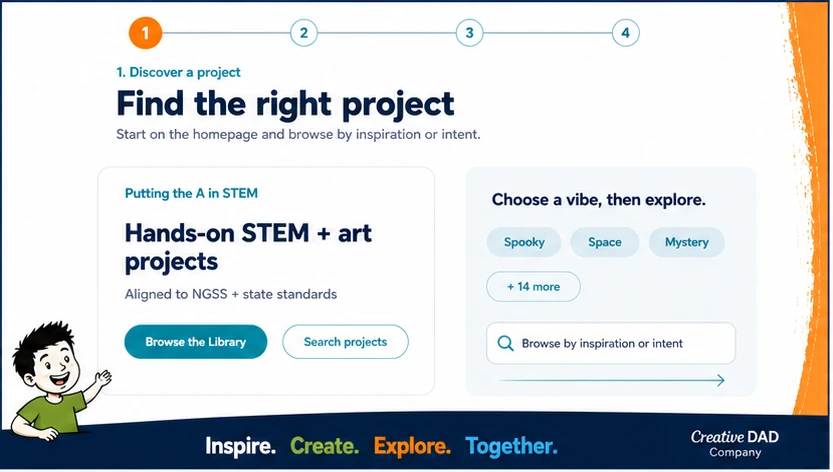
Every level is a real, hands-on experience
Quick Start isn’t a lesser version — it’s the same immersive idea, right-sized for today.
Quick Start
The same real activity, stripped to its leanest form — minimal prep, materials you already have, done in one sitting.
Full Experience
The complete build, with real materials and a bit more setup — the fully realized version of the project.
Total Transformation
A full immersive event — the room becomes the world of the project, with props, roles to play, and a real audience for the showcase.
One project. Three ways to run it.
Real project, real numbers — this is exactly what changes when you pick a level for “Constellation Storytelling Lanterns.”
Constellation Storytelling Lanterns
Just black paper, push pins, and LED tea lights — punch the constellation, read the myth aloud, and you're done in one sitting.
Real standards. $14.99/month.
Browsing is free. Membership unlocks the printable packs and atmosphere kits for every standards-mapped project.
Become a member — $14.99/monthWhy not just use worksheets or a search engine?
| Generic worksheets | Generic craft kits | Random search results | Creative Dad Company | |
|---|---|---|---|---|
| Standards-aligned (NGSS + state) | ✓ | ✕ | ✕ | ✓ |
| Hands-on materials included | ✕ | ✓ | ✕ | ✓ |
| Blends art + storytelling, not just science | ✕ | ✕ | ✕ | ✓ |
| Multiple difficulty levels for one idea | ✕ | ✕ | ✕ | ✓ |
| Ready-to-buy shopping list | ✕ | ✓ | ✕ | ✓ |
This isn’t just our opinion
Blending art into STEM is a real, studied approach — here’s what the research actually says.
Combining art with STEM instruction has been shown to increase engagement, improve access for groups underrepresented in STEM, and improve learning outcomes.
International Journal of STEM Education, 2022 ↗In a classroom study, leading with the art before the science produced significantly higher science learning gains than teaching the science first.
Discover Education (Springer Nature), 2024 ↗Arts-integrated STEM has been linked to higher student self-efficacy and STEM-specific interest — not just enjoyment of the activity itself.
Bridging Art and Science, SCIRP, 2023 ↗“The goal is to foster the true innovation that comes with combining the mind of a scientist with that of an artist or designer.”
Rhode Island School of Design, on why it started the STEM-to-STEAM movement ↗Questions? Answers.
Do I need a science background to run these?+
No. Every project comes with plain-language setup and activity steps, and the Quick Start version needs no special equipment or expertise — just common or recycled materials.
What if my budget is tight?+
Every project has a Quick Start version that is $0 to buy. Printing is noted separately. Full Experience and Total Transformation are priced per class, for a class of about 30 students in 6 groups. A Full Experience total over $25 per class is flagged on the project page. Those dollar amounts are materials costs, not the membership price.
Is this for classrooms, afterschool programs, or home?+
All three. It's built for afterschool programs and homeschool families, and classroom teachers use it too.
Do these actually count toward standards?+
Yes — every project in the library is tied to real NGSS or state standards you can see on its page. There's also a free Standards Checker tool if you want to check your own lesson idea.
What's actually free versus paid?+
Browsing the full library, every commitment level for every project, and the Standards Checker are free. Membership is $14.99/month and unlocks the printable packs and atmosphere kits. Create an account, then click Subscribe for $14.99/month on the Account page.
Where do the materials come from?+
Each project links to real products you can buy. Materials links go to Amazon. Prices are estimates and may change.
Find your next STEM + art project
Search a growing library of projects that blend real science standards with art, music, history, and storytelling — built for afterschool programs and homeschoolers alike.
109 projects found
Water Infrastructure Commission
Students design a simple water system for a pretend town. They balance the real costs of cleaning water and piping it to homes, and make sure every neighborhood gets fair access. It is civil engineering with a strong thread of fairness.
Materials list · 1 itemCybersecurity Operations Center
Students run a mock security operations center. They study pretend login attempts and network activity to spot real attack patterns, then write plain-language rules to defend against them. It is great for anyone who likes puzzles, patterns, and a bit of detective work.
Materials list · 1 itemAlgorithmic Music Studio
Students turn real science data, like temperature records or earthquake data, into a short piece of music by matching numbers to notes. Then they test whether listeners can hear the pattern in the data. This is called data sonification, and it is a lot of fun.
E-Commerce Fulfillment Lab
Students improve a mock online-store warehouse. They pack boxes to cut shipping costs based on box size and weight, and plan how to send out orders quickly so customers stay happy. It is geometry and planning with a real money payoff.
Materials list · 3 itemsElection-System Design Commission
Students design a voting system for a mock election. They balance security, ease of use, and access for everyone, then stress-test it against real problems like long lines and tampering. It is civics and engineering rolled into one lively debate.
Futures Museum
Students make a museum exhibit of invented objects from the future, like a 2075 recycling bin or a school desk built for a changing climate. Each one is backed by real science reasoning about how the future could believably get there. It is design about the future that is based on real evidence.
Robotic Wildlife Monitor
Students build a simple sensor rig, like a motion-triggered camera trap, to watch real local wildlife. Then they write a plan for collecting data that keeps the animals undisturbed. It is field biology powered by a bit of electronics.
Climate Adaptation Consultancy
Students act as consultants who help a town get ready for changes in climate. They use real public climate and map data about their own town to suggest real local fixes, like more shade or flood-smart landscaping. It brings a huge world topic down to a place you can walk to.
Synthetic-Biology Ethics Council
Students study an idea from synthetic biology, like a modified crop or bacteria, using only paper and diagrams. Then they hold a council to debate its risks and benefits without ever touching a real lab bench. It makes big ideas about science and ethics easy to picture.
Sustainable Fashion Lab
Students compare real fabric swatches, like cotton, polyester, and recycled blends, for how long they last, how much waste they make, and their effect on the environment. Then they design a small garment or accessory that puts the best choice to the test. It is craft time with a real research backbone.
Music Festival Systems Lab
Students plan the behind-the-scenes parts of a mini music festival: power, speaker placement, stages, and how a crowd moves between two stages. They use a scaled-down real place like a backyard or gym. It is systems thinking with a soundtrack.
Materials list · 1 itemSatellite Emergency Network
Students design a backup emergency network that keeps working when cell towers and the normal internet go down. They use simple relay and range ideas to plan coverage. It is strong-systems thinking for a very real disaster.
Virtual Production Stage
Students build a mini virtual production setup with a school device camera, a simple backdrop, and printed background images. They fake being somewhere they are not, the same trick big movie studios use. It is a hands-on intro to how modern filmmaking really works.
Materials list · 2 itemsProsthetics and Performance Lab
Students build two versions of a simple model hand or limb inspired by prosthetics. One is built only to work well, and one is built for movie-style looks. They compare how real engineering and movie engineering solve the same problem. It is a fascinating side-by-side comparison.
Materials list · 1 itemSports Analytics Department
Students turn a stack of real sports data, like shooting percentages or sprint times, into a clear, testable idea a coach could really use. It is a perfect project for a sports fan who likes stats.
Materials list · 3 itemsSound Wave Visualizer & Original Composition
Students use a free audio tool to see the waveforms of different sounds. Then they compose a short original piece that plays with pitch and loudness.
Carbon-Capture Investment Panel
Students act as an investment panel that judges real carbon-capture technologies. They look closely at the evidence behind each company's claims about size, energy use, and real effect on the climate. It is numbers-first climate learning.
Materials list · 1 itemRepair Café Engineering
Students run a mini repair café. They figure out what is wrong with broken household gadgets and toys, fix what they can, and count how much waste they kept out of the landfill. It is hands-on troubleshooting with a feel-good payoff.
Materials list · 1 itemSmart-Home Privacy Lab
Students wire up a simple smart-home helper, like a light that turns on with motion. Then they switch roles and think like a privacy detective: what data could a device like that collect, and who might want it? It is half maker project and half privacy check.
Materials list · 2 itemsCommunity Broadband Planner
Students plan internet coverage for a mock town. They model how a signal gets weaker with distance and rough land, then find the fewest towers or access points that can reach everyone within a budget. It is geometry in action, with a focus on fairness.
Future Transportation Firm
Students compare future transportation choices, like electric, hydrogen, and hyperloop-style ideas, for one real route. They weigh the pros and cons of power, the roads or tracks needed, and pollution in an honest way. It is a big engineering debate based on real numbers.
Genetics Through Folklore: Inheritance Story Comic
Students draw a comic about a trait that is passed down through a family over several generations. They use Punnett squares to plan the story.
Materials list · 1 itemRenewable-Energy Cooperative
Students compare real renewable energy options, like solar, wind, and battery storage, for one local site. They weigh how much power each could make against the cost to install and store it. It mixes time outdoors with spreadsheet-style decision making.
Scientific Claims Courtroom
Students put a real (or realistic) science claim on trial. First they repeat the experiment behind it themselves, then they argue whether the evidence really supports the headline. It is a great cure for believing every headline that says studies show something.
Materials list · 1 itemAI Hiring-System Tribunal
Students act as a prosecutor, a defense lawyer, and a judge in a mock trial about a pretend AI hiring tool. They study the tool's data and results to argue whether it treats people fairly. It is a strong way to learn about bias and who is responsible for computer decisions.
Extreme-Weather Broadcast Center
Students run a mock weather broadcast desk. They turn real live or recent weather data into clear advice for the public during a pretend severe-weather event. It is weather science and communication under real time pressure.
Planned-Obsolescence Investigation
Students take apart real products, old and new, to compare how easy they are to repair. Then they look into the business reasons that push companies to make products that do not last. It is part teardown and part money-detective story.
AI Talent Scout: Can the Machine Be Trusted?
Students form a review team for an AI system that sorts audition video clips for a talent agency. They build a simple rule-based system and a small trained AI model, then test both for accuracy and bias.
Startup Product Accelerator
Future inventors come up with a simple physical product, build a rough prototype, price out real materials, and pitch it to a panel of family or friends. It is a fast, fun crash course in turning an idea into something you could really sell.
Materials list · 1 itemCommunity Accessibility Consultancy
Students become accessibility consultants. They check a real local space, like a classroom, park, or store entrance, to see how well it works for people with different movement, vision, or hearing needs. Then they build a low-cost fix to test. This hands-on work turns the feeling that something is not fair into a design you can test.
Materials list · 2 itemsDeepfake Verification Desk
Students test real, publicly known ways of checking media against a set of changed and unchanged sample images or clips. Then they report honestly where those ways work and where they still fall short. It is critical digital literacy with real detective energy.
Citizen-Sensor Network
Students build simple sensors, like temperature or humidity readers, and calibrate (adjust) them against a trusted reference. Then they share honest local findings with clear notes about what the data can and cannot show. It is real citizen science, limits and all.
Biomedical Assistive Design
Students design and build a simple helper device, like a jar-opener grip or a page-turner, for one real person's needs. They test it with that person until it works well for them. It is engineering that puts the user first.
Materials list · 1 itemCourtroom Forensic Animation
Students recreate a pretend accident scene as a simple stop-motion or diagram animation. They must clearly mark every place where the animation is a guess instead of a fact. It is visual storytelling with honesty built in.
Supply-Chain Crisis Simulation
Students run a small factory through a pretend supply-chain crisis. They juggle stock, shipping delays, and risky choices as things go wrong. It is a lively, number-driven look at why store shelves sometimes go empty.
Materials list · 2 itemsArchitectural Visualization Firm
Students design a small building space and build a model to see how sunlight, air, and sound move through it. Then they check that a wheelchair user can really get around before calling it done. It is architecture that uses all four senses.
Materials list · 3 itemsWave Wavelength Watercolors
Students measure real wavelength and frequency in a rope or slinky wave and use math to find wave speed. Then they turn what they saw into a watercolor painting built entirely from that data.
Materials list · 3 itemsConcert in Crisis: Live Production Command
Students become the tech crew for a live concert with limited power, equipment, and time. They design the stage layout, how the sound travels, the lighting, and a backup plan. Then they keep the show going when something breaks just minutes before showtime.
Materials list · 3 itemsDocumentary Evidence Lab
Young filmmakers learn to fact-check like journalists while they make a short documentary. They compare sources and interviews before a single frame is edited. It is a great fit for anyone who loves storytelling and wants to make something that is accurate, not just convincing.
Materials list · 1 itemSpace Habitat Startup
Students start a pretend space habitat company. They must budget every gram of mass, watt of energy, liter of water, and calorie of food for a small crew, then defend their design against a system failure. It is real engineering with limits and very high stakes.
Materials list · 1 itemPublic-Health Outbreak Simulation
Students model how a pretend illness spreads through a small group of people. Then they have to share uncertain public-health decisions, like when to suggest closing a school, with a worried mock community. It shows how messy real disease decisions can be.
Materials list · 4 itemsNewton's Cradle Timeline
Students build a working Newton's cradle to test how momentum is conserved. Then they make a timeline that connects their result to the physicists whose ideas made it possible.
Materials list · 2 itemsRenewable Energy Public Art Installation
Students design a small moving or solar-powered sculpture for a school courtyard that teaches people walking by about one kind of renewable energy.
Materials list · 1 itemImmersive Theater Technology
Students design an immersive theater show with a branching story. The audience's choices set off real lighting, sound, or set changes through simple switches and cues. It is a great mix for theater fans and stage-tech fans.
Materials list · 1 itemAlternate-Reality Game Studio
Students design a mini alternate-reality game that links a real scavenger hunt to online puzzles. Each puzzle uses a real STEM idea that players must use to solve it. It is game design with real science and math inside.
Materials list · 1 itemReverse-Engineering Laboratory
Students safely take apart discarded electronics and appliances to map how they were built and work out exactly why they stopped working. It is part scavenger hunt and part detective story, with real aha moments about how things work.
Materials list · 1 itemTheme-Park Safety Review
Students model the physics forces on a simple roller-coaster loop. Then they step back to study the human side of safety, like how ride operators avoid mistakes during a busy shift. It is thrill-ride physics paired with real safety thinking.
Materials list · 4 itemsDisaster Logistics Command
Students act as emergency managers. They hand out limited trucks, supplies, and staff across a pretend disaster map where roads keep closing. It is a tense, strategic exercise in doing the most good when there is never quite enough.
Materials list · 2 itemsCircular-Economy Product Studio
Students design a product that is made from the start to be repaired, reused, and recycled. They add screws you can see, take-apart directions, and a tag so the product's whole life story can be followed. It is design where the ending is planned at the beginning.
Materials list · 1 itemFood-Truck Systems Challenge
Students design a mock food-truck menu and the way the kitchen works. They balance ingredient science, how fast food gets made, how much stock to keep, and prices so the truck could make a profit on a busy night. It is a tasty crash course in running a small business.
Materials list · 4 itemsWearable Technology House
Students design a piece of clothing with sensors, like a posture-tracking shirt or a step-counting shoe insert, for a real person's real need. They wire in simple electronics and improve it based on how it feels to wear. It is fashion meets circuits.
Materials list · 2 itemsCommunity Noise Commission
Teams measure real sound levels around a neighborhood, compare them to health guidelines, and defend a proposed fix to the loudest offender.
Materials list · 4 itemsCreature Motion-Capture Studio
Teams study an animal's real movement and translate it, frame by frame, into simple animation data for a digital creature.
Materials list · 3 itemsCounterfeit Product Lab
Teams compare a genuine and a counterfeit version of an everyday product, using measurements and material clues to figure out what gives the fake away.
Materials list · 3 itemsAtmospheric Probe Engineers
Teams build a protective shell for a fragile sensor, like an egg, and simulate a high-speed atmospheric descent to see if it survives.
Materials list · 4 itemsFuture Farm Control Room
Teams wire up simple soil-moisture sensors to control a model irrigation system, learning to automate watering instead of guessing on a schedule.
Materials list · 3 itemsAccessible Event Design Firm
Teams audit a mock live event space for accessibility gaps, then redesign the layout, signage, or seating so it actually works for every kind of guest.
Materials list · 3 itemsSocial-Media Algorithm Simulator
Teams hand-simulate a simplified content-ranking algorithm, watching how small rules about engagement can snowball into unintended outcomes like an echo chamber.
Materials list · 3 itemsSearch-and-Rescue Robot Course
Teams program a simple rolling robot to navigate a mock disaster course, then adapt its code on the fly when obstacles shift mid-mission.
Materials list · 4 itemsArchaeological Reconstruction Court
Teams examine replica artifacts and competing theories about how an ancient tool was made or used, then argue their case with physical evidence.
Materials list · 4 itemsMechanical Theater Company
Teams build a small mechanical puppet or scene piece that must move, light up, and play sound in sync to tell a short story without a human performer.
Materials list · 3 itemsAlien Language Decoder
Teams receive a set of symbolic alien signals and work backward to infer the grammar rules that generate them, then use those rules to predict the next message.
Materials list · 3 itemsWater-Quality Citizen Lab
Teams test a local water sample for basic indicators like pH and clarity, then communicate clearly what the results can and cannot tell the community.
Materials list · 3 itemsRoller-Coaster Queue Laboratory
Teams model how guests flow through a theme-park queue, calculating wait times and testing a redesign that keeps lines moving without cutting ride capacity.
Materials list · 3 itemsFood Packaging Startup
Teams design a simple package to protect a snack during shipping, testing insulation, cushioning, and material waste against a shipping drop test.
Materials list · 5 itemsPodcast Acoustics Rescue
Teams diagnose why a sample recording sounds echoey or muffled, then redesign the room with sound-absorbing materials until the audio sounds clean.
Materials list · 3 itemsEarthquake Recovery Architects
Teams test model buildings on a simple shake table, then plan which damaged community services — hospital, water, power — get rebuilt first with limited funds.
Materials list · 4 itemsSmart Costume Workshop
Teams sew simple LED circuits into a costume, learning how to hide wiring, manage a battery pack, and keep everything safe while a performer actually moves in it.
Materials list · 3 itemsRenewable Microgrid Command
Teams manage a simulated neighborhood microgrid, deciding in real time how to split solar and battery power between homes, a hospital, and a school when demand spikes.
Materials list · 3 itemsMuseum Interactive Exhibit Firm
Teams design a hands-on science exhibit for a museum audience, then watch real visitors use it to see if the exhibit teaches what it's supposed to.
Materials list · 3 itemsCold-Case Timeline Lab
Teams reconcile conflicting witness accounts, records, and physical measurements to build the most accurate timeline of a fictional cold case, respecting what the evidence can and can't prove.
Materials list · 4 itemsSynthetic Ecosystem Simulator
Teams code a simple predator-prey population simulation, then test whether it stays balanced or spirals into extinction and booms.
Materials list · 3 itemsSpace Colony Election
Teams design a voting system for a fictional space colony choosing how to allocate scarce resources, then stress-test it for fairness when factions disagree.
Materials list · 3 itemsCardboard Automation Factory
Teams design a small cardboard factory line with simple sensors and mechanisms that sorts or moves objects automatically, then work to speed up its throughput.
Materials list · 4 itemsCosmetics Formulation Studio
Teams formulate a simple lotion or lip balm, testing how ingredient ratios change its texture, color, and how long it stays stable before separating.
Materials list · 3 itemsFuture Transit Authority
Teams compare transit route options for a growing city, weighing energy use, passenger capacity, and accessibility to recommend the best system.
Materials list · 3 itemsConcert Laser-Show Simulator
Teams choreograph a mock laser and light show, using geometry and timing to sync beams with music without ever pointing a real laser at anyone.
Materials list · 3 itemsWildlife Rehabilitation Technology
Teams prototype a simple monitoring or assistive device, like a heated recovery box or an activity tracker, to help an injured wild animal heal and be tracked safely.
Materials list · 3 itemsArcade Economy Audit
Teams analyze a simple arcade-style game's odds and payouts, calculating whether it's actually fair to players or quietly stacked in the house's favor.
Materials list · 5 itemsOcean Research Vessel
Teams design a miniature sampling device that can survive being lowered into deep water, balancing the pressure it will face against the buoyancy it needs to float back up.
Materials list · 4 itemsViral Video Verification Desk
Teams act as fact-checkers, examining a suspicious viral video for clues in its metadata, lighting, and physics to determine whether it's real, staged, or manipulated.
Materials list · 3 itemsHistorical Siege Engineering Trial
Teams research a real historical siege engine, like a trebuchet or battering ram, build a working scale model, and put popular claims about it on trial.
Materials list · 4 itemsDrone Disaster-Mapping Simulation
Teams plan a simulated drone flight path to map a disaster zone, balancing full area coverage against a strict battery-life limit.
Materials list · 3 itemsTiny-House Client Challenge
Teams design a tiny house floor plan for a fictional client, balancing square footage, utility hookups, accessibility needs, and a strict budget.
Materials list · 3 itemsSports Biomechanics Lab
Athletes-turned-scientists film a throw, swing, or jump in slow motion, measure joint angles, and redesign equipment or technique to improve performance.
Materials list · 6 itemsInteractive Horror Experience
Teams program a mini haunted-house scene where motion sensors trigger lights, sound, and a branching scare sequence, then tune the timing until it actually startles instead of falling flat.
Materials list · 4 itemsCybersecurity Training Mission
Teams role-play as a security team defending a fake company account, learning how weak passwords, phishing tricks, and human mistakes open the door for attackers.
Materials list · 4 itemsFlood-Resilient City Studio
Young urban planners model a flood-prone neighborhood and test drainage designs, weighing tradeoffs between protecting homes, roads, and green space on a tight budget.
Materials list · 4 itemsProsthetic Creature Effects
Special-effects designers build a working prosthetic limb or tail for a costume creature, combining hinges and cables with performance so the movement matches how the creature would really move.
Materials list · 3 itemsParanormal Claims Laboratory
Kids design fair tests for spooky claims — like a haunted object or a dowsing rod — using blind trials and controls to see what evidence actually holds up.
Materials list · 4 itemsEscape-Room Mechanism Company
Teams design and build a physical puzzle mechanism — a lock, a hidden lever, a chain reaction — for a mini escape room, then playtest it on real guests to make sure it's fair, not frustrating.
Materials list · 5 itemsUrban Heat Response Agency
Teams study why some neighborhoods run hotter than others and prototype a low-cost cooling fix, like reflective surfaces or shade structures, then test it with real thermometers.
Materials list · 3 itemsSustainable Restaurant Test Kitchen
Junior chefs prototype a menu item while tracking ingredient cost, energy use, and food waste, learning that sustainable and delicious have to be solved together.
Materials list · 3 itemsAI Creature Field Guide
Kids train a simple image-classifying tool to sort fantasy creatures into categories, then hunt for the hidden biases and mistakes baked into their own training data.
Materials list · 3 itemsFestival Sound Engineering
Teams design speaker placement for a mock outdoor stage, balancing full audience coverage against the screeching feedback loop that happens when a mic gets too close to a speaker.
Materials list · 3 itemsIndie Game Physics Studio
Aspiring game designers code a simple 2D character and tune gravity, friction, and bounce until the movement feels satisfying instead of floaty or stiff.
Materials list · 5 itemsForensic Crash Reconstruction
Using skid-mark evidence and simple measurements, young investigators calculate speed and impact angles to reconstruct how a toy-car crash happened.
Materials list · 4 itemsMars Mission Control
Teams run a simulated Mars habitat, juggling limited power, water, food, and communication delay while an unpredictable mission event forces them to adapt on the fly.
Materials list · 3 itemsAnimatronic Creature Shop
Kids design a creature powered by simple mechanisms — cams, levers, servos — and bring it to life with programmable motion, blending sculpture with robotics.
Materials list · 3 itemsEscape from the Climate Archive
A future archive has locked down because its climate records look corrupted. Students solve connected puzzles using real temperature graphs, precipitation records, and carbon-cycle models to restore it — including one dataset with a suspicious outlier.
Materials list · 2 itemsBlackout at Monster Movie Studios
Students are the practical-effects crew on a monster movie after the digital effects system fails. They use real optics, scale, and lighting to build a convincing in-camera effect — no computer required.
Materials list · 3 itemsSound Wave Sculpture Symphony
A homemade box guitar turns string tension and length into pitch kids can hear and measure, and the finished instrument doubles as a piece of playable art.
Materials list · 2 itemsThermal Time Capsule
Teams engineer an insulated box to keep an ice cube frozen as long as possible, then write a field journal entry in the voice of a 19th century ice harvester who solved the same problem before refrigerators existed.
Materials list · 4 itemsNewton's Laws Sound Machines
A balloon powered car turns Newton's laws into something kids can watch race across the floor, then they turn its changing speed into a simple soundtrack.
Materials list · 4 itemsScratch Ecosystem Food Web Game
Code an interactive Scratch game where players keep a food web balanced, turning ecosystem science into playable storytelling.
Chemistry of Color: Natural Dye & Textile Art
Extract natural dyes from onion skins, turmeric, and berries to dye fabric squares, tying chemistry to historic textile traditions.
Materials list · 3 itemsMapping Plate Tectonics Through Historical Earthquakes
Plot historical earthquakes on a world map to reveal plate boundaries and connect the science to real historical events.
Materials list · 2 itemsDa Vinci Bridge Engineering Challenge
Recreate Leonardo da Vinci's self-supporting bridge design using only wooden dowels, no fasteners, then load-test it.
Materials list · 3 itemsSong of Photosynthesis Music Video
Write and record an original song that explains photosynthesis, then illustrate it as a lyric video.
Materials list · 3 items