 Putting the A in STEM
Inspire Your Child’s Creativity
Most STEM resources are either dry and standards-mapped, or fun but disconnected from any standard. Creative Dad Company gives you both — hands-on STEM + art projects that are genuinely fun and tied to real education standards, made for afterschool programs and homeschoolers.
✓ Aligned to real NGSS + state education standards
Running a program instead of a single family? Talk to us about a site license.
How it works
Every level is a real, hands-on experience
Quick Start isn’t a lesser version — it’s the same immersive idea, right-sized for today.
Quick Start
The same real activity, stripped to its leanest form — minimal prep, materials you already have, done in one sitting.
Full Experience
The complete build, with real materials and a bit more setup — the fully realized version of the project.
Total Transformation
A full immersive event — the room becomes the world of the project, with props, roles to play, and a real audience for the showcase.
One project. Three ways to run it.
Real project, real numbers — this is exactly what changes when you pick a level for “Constellation Storytelling Lanterns.”
Constellation Storytelling Lanterns
Just black paper, push pins, and LED tea lights — punch the constellation, read the myth aloud, and you're done in one sitting.
This whole walkthrough is free right now.
Sign up to save projects, and subscribe any time to unlock the printable packs and atmosphere kits for every project in the library.
Sign Up & Get a Free LessonWhy not just use worksheets or a search engine?
| Generic worksheets | Generic craft kits | Random search results | Creative Dad Company | |
|---|---|---|---|---|
| Standards-aligned (NGSS + state) | ✓ | ✕ | ✕ | ✓ |
| Hands-on materials included | ✕ | ✓ | ✕ | ✓ |
| Blends art + storytelling, not just science | ✕ | ✕ | ✕ | ✓ |
| Multiple difficulty levels for one idea | ✕ | ✕ | ✕ | ✓ |
| Ready-to-buy shopping list | ✕ | ✓ | ✕ | ✓ |
This isn’t just our opinion
Blending art into STEM is a real, studied approach — here’s what the research actually says.
Combining art with STEM instruction has been shown to increase engagement, improve access for groups underrepresented in STEM, and improve learning outcomes.
International Journal of STEM Education, 2022 ↗In a classroom study, leading with the art before the science produced significantly higher science learning gains than teaching the science first.
Discover Education (Springer Nature), 2024 ↗Arts-integrated STEM has been linked to higher student self-efficacy and STEM-specific interest — not just enjoyment of the activity itself.
Bridging Art and Science, SCIRP, 2023 ↗“The goal is to foster the true innovation that comes with combining the mind of a scientist with that of an artist or designer.”
Rhode Island School of Design, on why it started the STEM-to-STEAM movement ↗Questions? Answers.
Do I need a science background to run these?+
No. Every project comes with plain-language setup and activity steps, and the Quick Start version needs no special equipment or expertise — just common or recycled materials.
What if my budget is tight?+
Every project has a Quick Start version that runs $1–5 per group using paper and recycled materials. Full Experience and Total Transformation are optional upgrades, not requirements.
Is this for classrooms, afterschool programs, or home?+
All three. It's built for afterschool programs and homeschool families, and classroom teachers use it too.
Do these actually count toward standards?+
Yes — every project in the library is tied to real NGSS or state standards you can see on its page. There's also a free Standards Checker tool if you want to check your own lesson idea.
What's actually free versus paid?+
Browsing the full library, every commitment level for every project, and the Standards Checker are free. A subscription unlocks the extra atmosphere ideas, printable packs, and digital tools for each project.
Where do the materials come from?+
Each project links to real products you can buy — no guessing what to shop for. We're an Amazon Associate, and that's disclosed on every materials list.
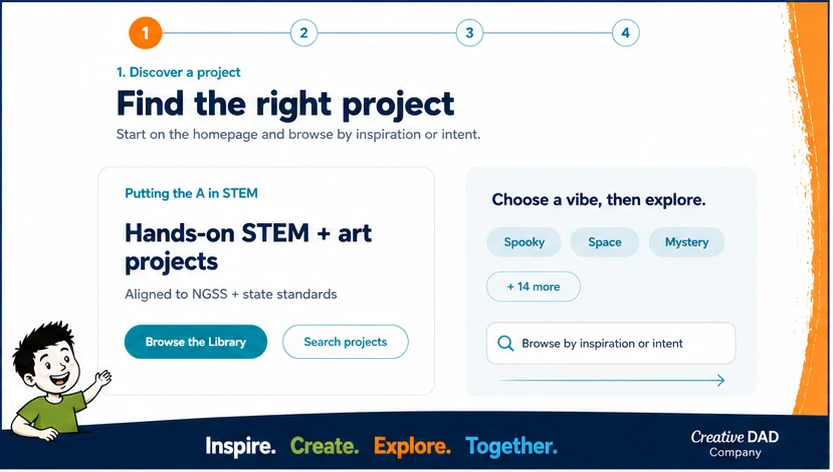
Find your next STEM + art project
Search a growing library of projects that blend real science standards with art, music, history, and storytelling — built for afterschool programs and homeschoolers alike.
24 projects found
Robotic Wildlife Monitor
Students build a simple non-invasive sensor rig—like a motion-triggered camera trap—to observe real local wildlife activity, then write a data-collection protocol that keeps the animals undisturbed. It's field biology powered by a bit of electronics.
Materials list · 3 itemsCreature Motion-Capture Studio
Teams study an animal's real movement and translate it, frame by frame, into simple animation data for a digital creature.
Materials list · 3 itemsSynthetic Ecosystem Simulator
Teams code a simple predator-prey population simulation, then test whether it stays balanced or spirals into extinction and booms.
Materials list · 3 itemsWildlife Rehabilitation Technology
Teams prototype a simple monitoring or assistive device, like a heated recovery box or an activity tracker, to help an injured wild animal heal and be tracked safely.
Materials list · 3 itemsPuppet Biome Research Center
Kids build a puppet with mechanical features, like a snapping beak, camouflage flaps, or a long tongue, that mimics a real animal's adaptation, then perform a short skit demonstrating how that adaptation helps it survive. It's biology brought to life through hands-on puppetry.
Materials list · 3 itemsMonster Habitat Architects
Kids invent a monster with specific food-web needs, then design a habitat that supplies everything it needs to survive within a set of size and material constraints. It's a wildly creative spin on ecosystem design that still demands real logical trade-offs.
Materials list · 3 itemsPollinator City Council
Kids study real data about local pollinators, then redesign a model park or schoolyard with the plants and features that would actually attract and support them. It's an ecosystem lesson that ends in kids advocating for a real, buildable idea.
Materials list · 3 itemsZoo Enrichment Designers
Kids research how a real animal uses its senses and instincts, then build a simple enrichment device, like a puzzle feeder or scent trail, to test whether it actually engages the animal's natural behaviors. It's animal-loving kids' favorite kind of engineering.
Materials list · 3 itemsMystery Ecosystem Escape Room
Kids solve a series of food-web puzzles and evidence clues to unlock the mystery of what's disrupting a fictional ecosystem. It's escape-room excitement built entirely on real ecological reasoning, so the fun and the learning are the same thing.
Materials list · 3 itemsWildlife Crossing Commission
Kids study where model animals get hit crossing a busy road, then design and test a bridge, tunnel, or fence system to keep them safe. It connects real wildlife-conservation engineering to a satisfying, visual before-and-after model.
Materials list · 3 itemsCreature Robotics Laboratory
Kids study how real animals move, from flapping to crawling to slithering, then build a simple mechanical creature that mimics one of those motions using levers, gears, or rubber bands. It's a playful entry point into biomechanics and robotics that rewards clever tinkering over perfection.
Materials list · 3 itemsBird-Nest Engineering Firm
Kids build a nest from natural materials and put it through wind, rain, and weight tests. It's a hands-on way to appreciate how cleverly real birds engineer their homes.
Materials list · 3 itemsBee Communication Dance
Kids become worker bees and learn to point their hive-mates toward hidden flowers using only movement. It's a lively way to explore animal communication through dance instead of words.
Materials list · 3 itemsAnimal Prosthetics Clinic
Compassionate young engineers design mobility aids for toy animals with pretend injuries. It's a sweet way to explore how real animal bodies work while building empathy and engineering skills.
Materials list · 3 itemsBird-Beak Breakfast
Kids test spoons, tweezers, and straws as stand-ins for different bird beaks to see which tool eats each breakfast food best. A hands-on way to connect body parts to the jobs they do.
Materials list · 3 itemsSleepy Zoo Night Shift
Kids sort zoo animals by whether they sleep or work at night, then explore a dark den with a flashlight to imagine seeing like a nocturnal animal. A cozy, curious dive into nighttime adaptations.
Materials list · 3 itemsEgg Carton Bug Hotel
Kids design cozy little rooms in an egg carton suited to different garden bugs' needs, then check in their tiny guests. A gentle, low-cost way to explore habitats and insect needs.
Materials list · 3 itemsGarden Pollinator Café
Kids match pretend bees and butterflies to the flowers and foods they need, discovering how pollinators help gardens grow. A colorful, tactile introduction to pollination.
Materials list · 3 itemsAnimal Home Architects
Kids match animals to the homes they need, then build a tiny model shelter suited to that creature's size and habits. A gentle way to connect living things to their environments through hands-on building.
Materials list · 3 itemsLost Penguin Rescue
Kids test foil, cotton, and felt to find the best insulation for keeping a lost penguin's icy home from melting. A cool, hands-on intro to insulation for the youngest scientists.
Materials list · 3 itemsBusy Beaver Building Crew
Young engineers channel their inner beaver, stacking sticks and mud to hold back a stream of water and see what it really takes to build a dam. Messy, hands-on, and full of leaky surprises that lead to real problem-solving.
Materials list · 3 itemsBaby Dinosaur Nursery
Little paleontologists design a cozy, safe nest for baby dinosaurs, thinking through warmth, protection, and food just like real zookeepers. A gentle, tactile way to talk about what living things need to grow up strong.
Materials list · 3 itemsVery Hungry Caterpillar Café
Kids run a café for caterpillars and butterflies, investigating what each life stage actually needs to eat and where it lives, then build a menu and habitat that's scientifically correct for a surprise customer.
Materials list · 2 itemsScratch Ecosystem Food Web Game
Code an interactive Scratch game where players keep a food web balanced, turning ecosystem science into playable storytelling.