 Putting the A in STEM
Inspire Your Child’s Creativity
Most STEM resources are either dry and standards-mapped, or fun but disconnected from any standard. Creative Dad Company gives you both — hands-on STEM + art projects that are genuinely fun and tied to real education standards, made for afterschool programs and homeschoolers.
✓ Aligned to real NGSS + state education standards
Running a program instead of a single family? Talk to us about a site license.
How it works
Every level is a real, hands-on experience
Quick Start isn’t a lesser version — it’s the same immersive idea, right-sized for today.
Quick Start
The same real activity, stripped to its leanest form — minimal prep, materials you already have, done in one sitting.
Full Experience
The complete build, with real materials and a bit more setup — the fully realized version of the project.
Total Transformation
A full immersive event — the room becomes the world of the project, with props, roles to play, and a real audience for the showcase.
One project. Three ways to run it.
Real project, real numbers — this is exactly what changes when you pick a level for “Constellation Storytelling Lanterns.”
Constellation Storytelling Lanterns
Just black paper, push pins, and LED tea lights — punch the constellation, read the myth aloud, and you're done in one sitting.
This whole walkthrough is free right now.
Sign up to save projects, and subscribe any time to unlock the printable packs and atmosphere kits for every project in the library.
Sign Up & Get a Free LessonWhy not just use worksheets or a search engine?
| Generic worksheets | Generic craft kits | Random search results | Creative Dad Company | |
|---|---|---|---|---|
| Standards-aligned (NGSS + state) | ✓ | ✕ | ✕ | ✓ |
| Hands-on materials included | ✕ | ✓ | ✕ | ✓ |
| Blends art + storytelling, not just science | ✕ | ✕ | ✕ | ✓ |
| Multiple difficulty levels for one idea | ✕ | ✕ | ✕ | ✓ |
| Ready-to-buy shopping list | ✕ | ✓ | ✕ | ✓ |
This isn’t just our opinion
Blending art into STEM is a real, studied approach — here’s what the research actually says.
Combining art with STEM instruction has been shown to increase engagement, improve access for groups underrepresented in STEM, and improve learning outcomes.
International Journal of STEM Education, 2022 ↗In a classroom study, leading with the art before the science produced significantly higher science learning gains than teaching the science first.
Discover Education (Springer Nature), 2024 ↗Arts-integrated STEM has been linked to higher student self-efficacy and STEM-specific interest — not just enjoyment of the activity itself.
Bridging Art and Science, SCIRP, 2023 ↗“The goal is to foster the true innovation that comes with combining the mind of a scientist with that of an artist or designer.”
Rhode Island School of Design, on why it started the STEM-to-STEAM movement ↗Questions? Answers.
Do I need a science background to run these?+
No. Every project comes with plain-language setup and activity steps, and the Quick Start version needs no special equipment or expertise — just common or recycled materials.
What if my budget is tight?+
Every project has a Quick Start version that runs $1–5 per group using paper and recycled materials. Full Experience and Total Transformation are optional upgrades, not requirements.
Is this for classrooms, afterschool programs, or home?+
All three. It's built for afterschool programs and homeschool families, and classroom teachers use it too.
Do these actually count toward standards?+
Yes — every project in the library is tied to real NGSS or state standards you can see on its page. There's also a free Standards Checker tool if you want to check your own lesson idea.
What's actually free versus paid?+
Browsing the full library, every commitment level for every project, and the Standards Checker are free. A subscription unlocks the extra atmosphere ideas, printable packs, and digital tools for each project.
Where do the materials come from?+
Each project links to real products you can buy — no guessing what to shop for. We're an Amazon Associate, and that's disclosed on every materials list.
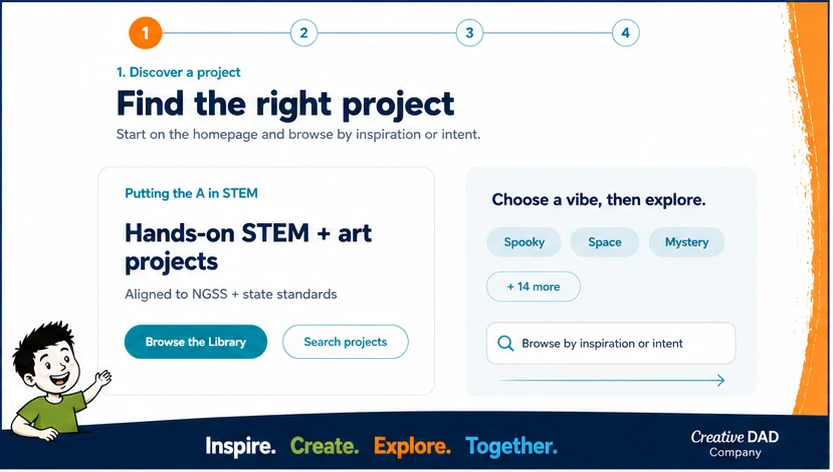
Find your next STEM + art project
Search a growing library of projects that blend real science standards with art, music, history, and storytelling — built for afterschool programs and homeschoolers alike.
28 projects found
Alternate-Reality Game Studio
Teens design a mini alternate-reality game that links a real physical scavenger hunt to online puzzles, each one built around an actual STEM concept the player has to use to solve it. It's game design with real academic teeth.
Materials list · 3 itemsCourtroom Forensic Animation
Students recreate a simulated accident scene as a simple stop-motion or diagram-based forensic animation, being careful to visually flag every place where the reconstruction is an estimate rather than a fact. It's visual storytelling with real intellectual honesty built in.
Materials list · 3 itemsDeepfake Verification Desk
Students test real, publicly documented media-authentication techniques against a set of altered and unaltered sample images or clips, then honestly report where those techniques succeed and where they still fall short. It's critical digital literacy with real detective energy.
Materials list · 3 itemsReverse-Engineering Laboratory
Students safely take apart discarded electronics and appliances to map out how they were built and diagnose exactly why they stopped working. It's part scavenger hunt, part detective story, with genuine 'oh, THAT'S how that works' moments.
Materials list · 3 itemsTrue-Crime Ethics Studio
Students produce a true-crime style podcast episode about a resolved case, working through how to handle real uncertainty and human tragedy without slipping into sensationalism. It's a thoughtful way to practice storytelling craft alongside media ethics.
Materials list · 3 itemsPlanned-Obsolescence Investigation
Teens dissect real consumer products—old and new—to compare how repairable they are, then investigate the business incentives that push companies toward products that don't last. It's part teardown, part economics detective story.
Materials list · 3 itemsDigital Forensics Investigation
Students reconstruct a timeline of events from an ethically-designed simulated case file—emails, timestamps, and photos—like a digital detective piecing together what really happened. Perfect for a teen who loves mysteries and paying close attention to detail.
Materials list · 3 itemsCybersecurity Operations Center
Teens run a mock security operations center, analyzing simulated suspicious login attempts and network activity to spot real attack patterns, then write plain-language policies to defend against them. Great for a teen who likes puzzles, patterns, and a bit of detective work.
Materials list · 3 itemsDocumentary Evidence Lab
Young filmmakers learn to fact-check like journalists while building a short documentary, cross-referencing sources and interviews before a single frame gets edited together. It's a great fit for a teen who loves storytelling but wants to make something rigorous, not just persuasive.
Materials list · 3 itemsCounterfeit Product Lab
Teams compare a genuine and a counterfeit version of an everyday product, using measurements and material clues to figure out what gives the fake away.
Materials list · 3 itemsAlien Language Decoder
Teams receive a set of symbolic alien signals and work backward to infer the grammar rules that generate them, then use those rules to predict the next message.
Materials list · 3 itemsCold-Case Timeline Lab
Teams reconcile conflicting witness accounts, records, and physical measurements to build the most accurate timeline of a fictional cold case, respecting what the evidence can and can't prove.
Materials list · 3 itemsViral Video Verification Desk
Teams act as fact-checkers, examining a suspicious viral video for clues in its metadata, lighting, and physics to determine whether it's real, staged, or manipulated.
Materials list · 3 itemsParanormal Claims Laboratory
Kids design fair tests for spooky claims — like a haunted object or a dowsing rod — using blind trials and controls to see what evidence actually holds up.
Materials list · 3 itemsEscape-Room Mechanism Company
Teams design and build a physical puzzle mechanism — a lock, a hidden lever, a chain reaction — for a mini escape room, then playtest it on real guests to make sure it's fair, not frustrating.
Materials list · 3 itemsForensic Crash Reconstruction
Using skid-mark evidence and simple measurements, young investigators calculate speed and impact angles to reconstruct how a toy-car crash happened.
Materials list · 3 itemsCommunity Heat-Island Detectives
Kids take temperature readings around different surfaces near school, like blacktop, grass, and shade, then map the hot spots and design a shade solution to cool the worst one down. It's real climate science with a project the school could actually use.
Materials list · 3 itemsForensic Art Laboratory
Kids measure footprints, shadows, and other evidence left at a staged scene, then use math and reasoning to reconstruct exactly what happened. It's a detective-style project that makes measurement and inference feel like real investigative work.
Materials list · 3 itemsSchool Energy Detectives
Kids audit real energy use around the school, like lights left on, drafty windows, or running faucets, then propose a specific, measurable change and track whether it actually saves energy. It's a genuinely useful project with a real-world payoff the school can act on.
Materials list · 3 itemsMystery Ecosystem Escape Room
Kids solve a series of food-web puzzles and evidence clues to unlock the mystery of what's disrupting a fictional ecosystem. It's escape-room excitement built entirely on real ecological reasoning, so the fun and the learning are the same thing.
Materials list · 3 itemsPlant Detective Agency
Kids play plant doctor, using clues from a wilting plant to diagnose what's gone wrong. It's a patient, observation-based project that turns everyday houseplants into a mystery to solve.
Materials list · 3 itemsNeighborhood Noise Detectives
Kids listen carefully around their neighborhood, record how loud different spots are, and suggest changes to make things calmer. It's a real-world way to explore sound while building community awareness.
Materials list · 3 itemsMystery Powder Detectives
Junior detectives use their senses and simple tests to identify unknown kitchen powders. It's a safe, hands-on introduction to observing properties and testing evidence like a real scientist.
Materials list · 3 itemsFirefly Signal School
Kids invent flashlight flash patterns to send secret messages across a dark room, just like real fireflies do. A glowing, playful introduction to communication and patterns of light.
Materials list · 3 itemsMonster Footprint Detectives
Little detectives measure, sort, and compare mystery monster tracks to crack the case of who's been stomping around. Builds early measurement and classification skills with a spooky-fun twist.
Materials list · 3 itemsEscape from the Climate Archive
A future archive has locked down because its climate records look corrupted. Students solve connected puzzles using real temperature graphs, precipitation records, and carbon-cycle models to restore it — including one dataset with a suspicious outlier.
Materials list · 2 itemsCryptid Camera-Trap Field Station
The classroom becomes a field station investigating reports of a mystery creature. Students analyze tracks, photos, and witness reports to separate strong evidence from weak claims, then design a fair camera-placement plan.
Materials list · 2 itemsRunaway Gingerbread Investigation
A gingerbread character has escaped and left clues around the room. Kids follow directional clues, then engineer a raft or bridge that can carry the character — and three counting bears — safely across a pretend river.
Materials list · 3 items